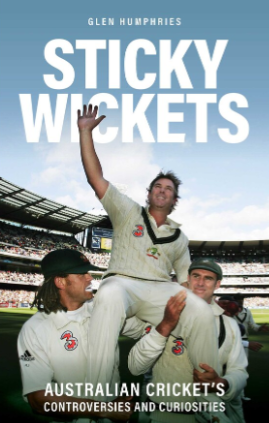
Sticky Wickets: Australian Cricket’s Controversies and Curiosities
Gelding Street Press
November 2023
$29.99
Buy it now at Dymocks, Readings, Booktopia or even Big W
About Sticky Wickets
The story of cricket is littered with big stories, like Bodyline, underarm balls and tycoons changing the game. But, like Tony Greig checking out the pitch with his keys, sometimes things fall through the cracks.
Sticky Wickets takes a look at stories both big, small and perhaps forgotten. From bees and their dislike of cricket to a storm caused when a cameraman criticised a Test player’s fielding. It’s perfect to pick up when rain delays play.
Read the introduction to Sticky Wickets
When you think about it, cricket is a strange and unique sport. For starters, it’s an outdoor sport which is dependent on good weather, lest a match be cut short. And yet, the spiritual home of the sport is England, where rain is a regular part of life. It’s the only sport where play is interrupted for a meal. It’s also likely the only sport that goes for five days and yet can end up with neither team winning.
Words have multiple meanings within the sport. Take wicket, instance; it can refer to the construction of stumps and bails at either end of the pitch, the pitch itself and also a batter’s dismissal. Even if she is out caught, we say she has lost her wicket, although it is completely intact.
The positions in other sports come with rational, obvious names that give the newcomer some indication of where they line up – fullback, full forward, goal defence, midfielder, goalkeeper. In cricket, we have gully, fine leg, cover, backward square leg and third man (which suggests positions called first and second man, even though neither exist). All of these positions require some understanding of the game before you know where they are.
In other sports, the guidelines about what you can and can’t do during play are called rules. In cricket, they’re called Laws, which suggests a drastic punishment is forthcoming for those who break them. And there are some strange laws in that book. Like Rule 31.1, which states an umpire may think a batsman out but is not allowed to say so unless a fielder appeals. Is there any other sport where the officials sees something but opts not to act unless asked by the opposite side?
There are modes of dismissal that are in the Laws of Cricket but not considered in the spirit of cricket – as though those are two completely separate things. A player can be out if they handle the ball or are at the non-striking end, leave the crease before the ball is bowled and the bowler breaks the stumps (obviously, they need to appeal as well). But woe betide any player who actually appeals for those dismissals, for they are considered not in the spirit of cricket.
Another in the usual modes of dismissal category is what happens if a batter takes too long to walk to the crease. When a wicket falls, the new batter has three minutes to get out to the middle, otherwise he is out. And, in case you’re wondering, the bowler doesn’t get to claim the scalp for his statistics.
Digging through the Laws throws up some other unusual moments. For instance, the bails aren’t compulsory – if both umpires agree, they can be removed and play is allowed to continue (this is usually in the case of strong winds blowing the bails off). Also, being bowled out trumps everything – if a batter suffers the misfortune of giving the umpire a choice of dismissals and one of them is bowled, then that’s the one it has to be. All the time.
So it’s really no surprise that strange and unusual moments form such a strong part of cricket’s tapestry. We’re talking about Dennis Lillee looking to plug his aluminium bat, Greg Chappell choosing to make his younger brother Trevor remembered for bowling underarm.
We’re talking about bees and their apparent dislike of cricket to the miniature talking version of a mustachioed cricketer being given away by a beer company.
Sure, there are some big, important moments too –Bodyline, that century of Steve Waugh’s and the creation of the Duckworth-Lewis method (yes, it involves a whole lot of maths and is therefore incomprehensible to most of us, but cricket would be so much the poorer without it). But just like those big moments stick with us, so do the strange and unusual ones. Which is why Sticky Wickets looks to cover the big, the small and the weird. And does so in such a way that makes it easy to read during a rain delay.
 Last Day of School