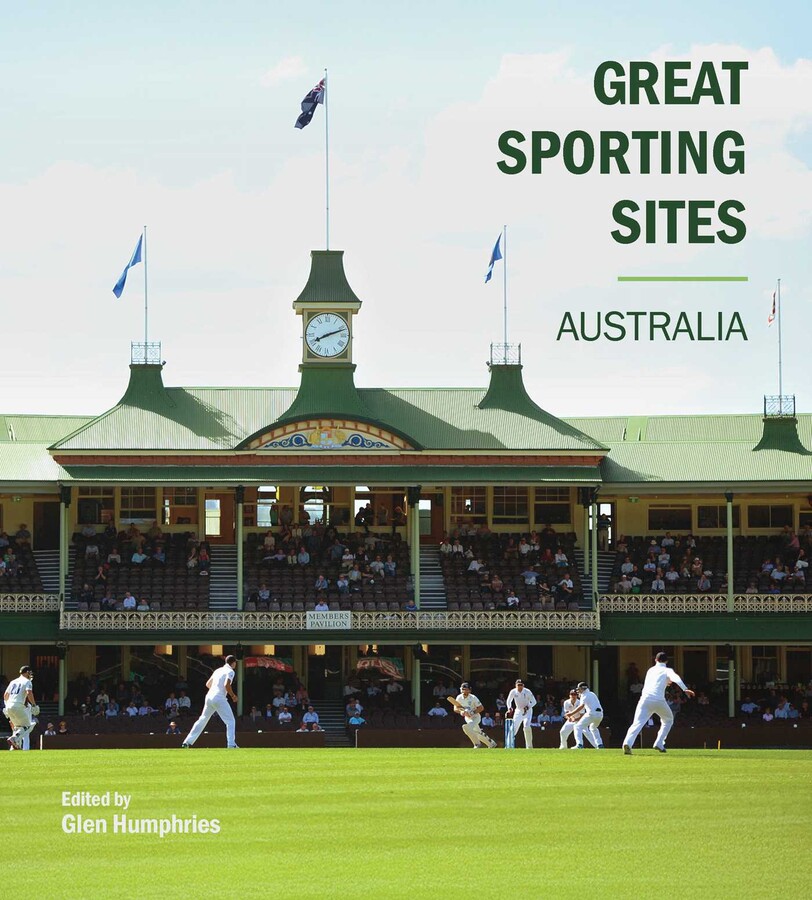
Great Sporting Sites: Australia
Edited by Glen Humphries
Gelding Street Press
July 2025
$39.95
“This is a bible for those seeking places of worship that align with their sporting values or that are of interest simply because of their legendary status.”
Sydney Morning Herald
The Blurb
Discover the iconic backdrops of Australia’s legendary sporting feats in this fully illustrated hardback book. From the fabled MCG to Mount Panorama and the legendary Gabba to Constitution Dock, discover the stories, legends and moments that make these places sacred. A must-read for fans, history buffs and travellers seeking Australia’s sporting soul. Great Sporting Sites: Australia showcases the iconic fields, racetracks, and stadiums that reflect the nation’s passion for sport. From the renowned Melbourne Cricket Ground (MCG) and Mount Panorama to the legendary Gabba and Constitution Dock, explore the stories, legends, and moments that make these venues sacred. This is a must-read for fans, history enthusiasts and travellers looking to connect with Australia’s sporting spirit.
Read an excerpt
Australia is a big country. And sport is a big part of that big country. From the heavily populated main cities to the Outback sport is there. It has seemingly always been here, even before white people showed up and decided to stay. The Kabi Kabi people of south Queensland played a game called Buroinjin, which sounds remarkably like touch footy. Played with a ball made of kangaroo skin, the aim was to run as far as possible and cross over a line at the other end of the field without being touched. Various tribes also played versions of tag and lawn bowls.
The most well-known First Nations game would be marngrook, largely because of the AFL’s insistent attempts to claim it as the origins of its own code (while ignoring the subtext of white people taking yet another thing from those who were here first). Not to worry, the reality is Australian rules can’t trace its origins to marngrook. Yes, the game that saw people kick the ball into the air and catch it does resemble Australian rules as we recognise it. But that’s not what Aussie rules looked like during its creation; it was one big scrum that moved around the field until someone got close enough to kick a ball through the posts.
White people brought a love of sport to Australia too; usually those that they could gamble on. Horses were brought over on the First Fleet, which soon paved the way for horse-racing by 1810. The Sydney Gazette, the first Australian newspaper, reported on a cock fight in 1805. While it tried to claim the sport was terrible, it also felt the need to give a complete match report. Kangaroo hunting was also considered a sport, as was shooting at pretty much anything else. Convicts and free settlers likely had their own sports but the Gazette seemed only interested in the sports of the upper classes.
From that start Australia grew to a nation so keyed into sport we ended up with multiple versions of it. We have four codes of football; there’s football (aka soccer), AFL, rugby league and rugby union. When it comes to cricket, we like to make hybrids – we got a 50-over version when Tests were deemed to go on for too long, then a 20-over match when those 50-over affairs suddenly seemed to move at a glacial pace. There are several sports that involve putting a ball through a hoop – netball and basketball – and at least three forms of animal racing in greyhound, horse and trotting.
Also, by some strange neurological quirk, we are able to become instant experts on any sport before us. Every time an Olympics rolls around, we are all able to discuss at length the nuances of any of those sports – including the ones we had never watched since the previous Games finished.
We make movies about our sport – The Club, The Great Macarthy, (AFL) Ride Like A Girl, The Cup (horse-racing), Dawn! (swimming), Backyard Ashes (cricket), Footy Legends, The Last Winter (rugby league), Crackerjack (lawn bowls) and Coolangatta Gold (surf life-saving). Though we excel at sport, we don’t do so well when it comes to excelling at making movies about sport.
But movie-length stories aren’t enough, we also go for sporting miniseries on TV – Bodyline, Howzat and Warnie (all cricket), The Challenge (about the 1983 America’s Cup triumph), Brock (motor racing), Tracks of Glory (cycling) and Cliffy (a biopic of ultramarathon shuffler Cliff Young).
Sport is so very important that it even warrants a day off in some states. Not a ‘day off’ in the sense of calling in sick, but a genuine government-sanctioned day of not going into work. Because it’s not like Australia already has too many public holidays as it is.
Victorians get a day off for the Melbourne Cup and the Friday before the AFL grand final (not the day of the grand final, but the day before the grand final). Even those Victorians who hate Aussie rules – there are about three of them – still get that day off. The other sporty state is South Australia, where residents get to stay away from the office for Adelaide Cup Day each year. Unless of course, if you work at the track where the cup is held.
We’ll also go and pay visits to the nation’s great sporting venues, even when there is no sport being played. Us Australians will pay good money to go on a tour of, say, the Melbourne Cricket Ground just so we can see the empty team locker rooms, the media area, walk down the players’ race and stand out on the turf. Maybe convincing ourselves we can feel the presence of those who have trodden on that turf before us.
Which brings us to this book. It’s an overview of the country’s legendary, iconic sporting fields, arenas, tracks and oceans. It not only touches on the obvious options –
like the major cricket grounds in each capital city, the fields where all those various codes of football occur – but also Constitution Dock where the Sydney to Hobart finishes and surfing venues Bells Beach and Margaret River. Even the Northern Territory boat race that gets cancelled in the event of water gets a mention. But it’s about more than just the venues, it’s the stories that happened there because they are the reasons why these places are revered.
And flicking through these pages might even give you inspiration for the next pilgrimage – or holiday if you want to call it that.
 Last Day of School