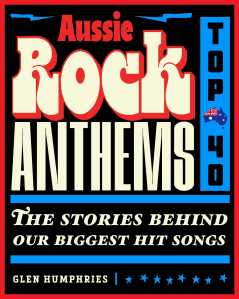
Aussie Rock Anthems: The Stories Behind Our Biggest Hit Songs
Gelding Street Press
July 2024
$39.99
“As author and journalist Glen Humphries explains in this entertaining book, what a song is about and what you think it’s about are not always the same.” – The Australian
“… it is original, patriotic, vivid, culturally-friendly and, most importantly, precise.” – Cream magazine
“A book that takes 40 of Australia’s biggest songs and goes deep into the weeds, looking at their importance, their popularity, and the interesting things you might not know.” – The Beat
“For those who are music aficionados, the book is a rich treasure trove of information. A lot of time and effort has gone into each chapter.” – Queensland Reviewers Collective
“Glen Humphries writes with passion and enthusiasm as he reveals the stories behind forty iconic Australian songs.” – Goodreads
“… a celebration of both the songs that have been on high rotation on AM and FM radio playlists throughout Australia for half a century, and also the decades when rock ruled the airwaves.” – Arts Hub
Buy it now at Collins Thirroul, Dymocks, Readings, Gleebooks and a bunch of other places.
What a famous song is about and what you think it’s about aren’t always the same thing. National Anthems names the top 40 classic Australian songs and tells the stories behind them – many unknown. From Hunters and Collectors’ Throw Your Arms Around Me to INXS’s Don’t Change and Red Gum’s I Was Only 19, author Glen Humphries unearths hidden gems and surprising back stories about the bands. It’s a celebration of great Australian music that will have you reaching for old vinyl or phone apps to give some of these classics another listen. Chances are, each song is not what you had assumed.
Read the introduction to Aussie Rock Anthems
What a song is about and what you think it’s about aren’t always the same thing. One famous example of that is Every Breath You Take by The Police. Some have taken it as an admission of eternal love, that whatever happens you’ll be by their side. And so it gets played at weddings all the time. While it is love Sting’s singing about; it’s not the nice sort of love. It’s the obsessive type – he’s singing about someone stalking their ex.
There’s also Bruce Springsteen’s Born in the USA, which people have seen in a patriotic context, when it’s actually critical of America. The catchy pop of Semi-Charmed Life by Third Eye Blind? That’s about smoking crystal meth. When it comes to Australian songs, The Go-Betweens’ Streets of Your Town is often seen as a fond ode to whatever town Grant McLellan was singing about – but that overlooks the dark references to domestic violence in the tune. Australian Crawl’s hit Boys Light Up is about … well, you can find out at No40 in this book. And, chances are, it’s not what you had assumed.
Though that’s not necessarily wrong. Once a songwriter lets their work out into the wild, they lose some ownership of it. They can’t sit on the lounge next to you, or the passenger seat of a car, when you listen to the tune, and tell you what it all means. They have to leave us to figure that out ourselves; and even if it’s wrong, it still works for us.
Some songwriters don’t like their songs being misinterpreted, especially when it’s used to support a cause or movement to which they are fundamentally opposed. Others are quite cool with people having their own interpretations, to the extent that they’re reluctant to spell out the truth behind a song. To their way of thinking, it increases the chance a tune will resonate with a listener if they’re allowed to create their own stories – even if it doesn’t match the lyrics.
That’s all worth knowing right at the start; that your locked-in, rock-solid ideas of the subject matter of songs that appear in the following pages may well be completely wrong. So don’t be disappointed.
Something else worth knowing is that the songs on this list are all old – the newest song is 2008’s My People by The Presets. There’s a good reason why nothing new and hip and what the kids are listening to today are included here. By their very nature, iconic songs need the passage of time to be considered iconic. A song needs to show it can stand the test of time, that it can still be hanging around decades later. Five to 10 years isn’t long enough to realise which songs resonated with us and which ones haven’t.
So, if you do the maths, that means the vast bulk of these tunes came out in the last century. That goes some way to explain a relative lack of female and First Nations artists – the Australian music scene back then wasn’t really blessed with a huge amount of diversity. If you weren’t white and male, you’d be pushing it uphill to get anywhere. Thank Christ that’s changed. If someone else writes a book like this 20 years from now, the list will be way more diverse.
Speaking of lists, any time someone creates a list that ranks anything, it’s a certainty that someone else will complain about why Thing X wasn’t ranked higher or how come Thing Y missed out altogether. So it needs to be said that any ranking will always be arbitrary. A range of factors come into play when working out who made the cut. Firstly, the rule was that each artist could only appear once; that way the top 40 doesn’t end up being clogged with Cold Chisel. Also, each song on the list had to pass the “sing test”. That’s where you read the song title and, without a conscious decision on your part, you start singing the song in your head. Even if you don’t like the band; an iconic song is one you’ve been exposed to so many times over the years; from radio stations to commercial jingles to the music that’s piped into the supermarket while you push that trolley with the wonky wheels around.
There were other more serious deliberations too. For instance, I felt a need to ensure both female and First Nations artists were represented in the top 10. And don’t go on about that being “woke” – I Touch Myself and Treaty both deserve to be in the top 10; but so did a lot of other songs. Daryl Braithwaite’s The Horses was in the top 10 only to miss out right as I was putting the finishing touches on this book. And the list isn’t made up of songs I like either; Eagle Rock is one of the most annoying songs ever written by an Australian and yet it made the cut (though I refused to listen to it while writing that chapter).
Likewise, people can make a case for any number of artists who should have made the cut. Should Olivia Newton-John have gotten a spot for Physical? Yeah, probably. And as much as I dislike Air Supply (though to be honest that dislike is more muted the older I get) the tall blonde and the dude with the afro wouldn’t have been out of place in the top 40 either. Little River Band, Savage Garden, The Saints, Russell Morris, Rose Tattoo, Billy Thorpe, Slim Dusty – you could create a top 40 of artists that didn’t get a look-in here.
In the end, it should be about celebrating the great Australian music that does feature, rather than bemoaning what missed out. If you do that, chances are you’ll pull out the old vinyl – or flick on Spotify – and give some of these classics a listen. If you’re going with the second option, I’ve helped you out a bit – go search for ‘Australian Anthems – The Playlist’ to hear all 40 songs in order.
 Last Day of School